Development8 min read
Claude Fable 5.2: benchmarks, price and the first independent test results
Claude Fable 5.2 costs $8/$40 per million tokens and tops Vals AI's index. Anthropic's benchmarks, independent results and what early testers report.
 By Hamza Ahmad AslamAI & WordPress Developer | Speed Optimization & Site Security
On this page
- What changed from Fable 5.1 to Fable 5.2?
- What do Anthropic's benchmarks show?
- Has anyone tested Fable 5.2 independently?
- What are early users and developers saying?
- What does Fable 5.2 cost per task?
- Should you switch to Claude Fable 5.2?
- Copy this model evaluation checklist
- Where Fable 5.2 fits in a business workflow
- Frequently asked questions
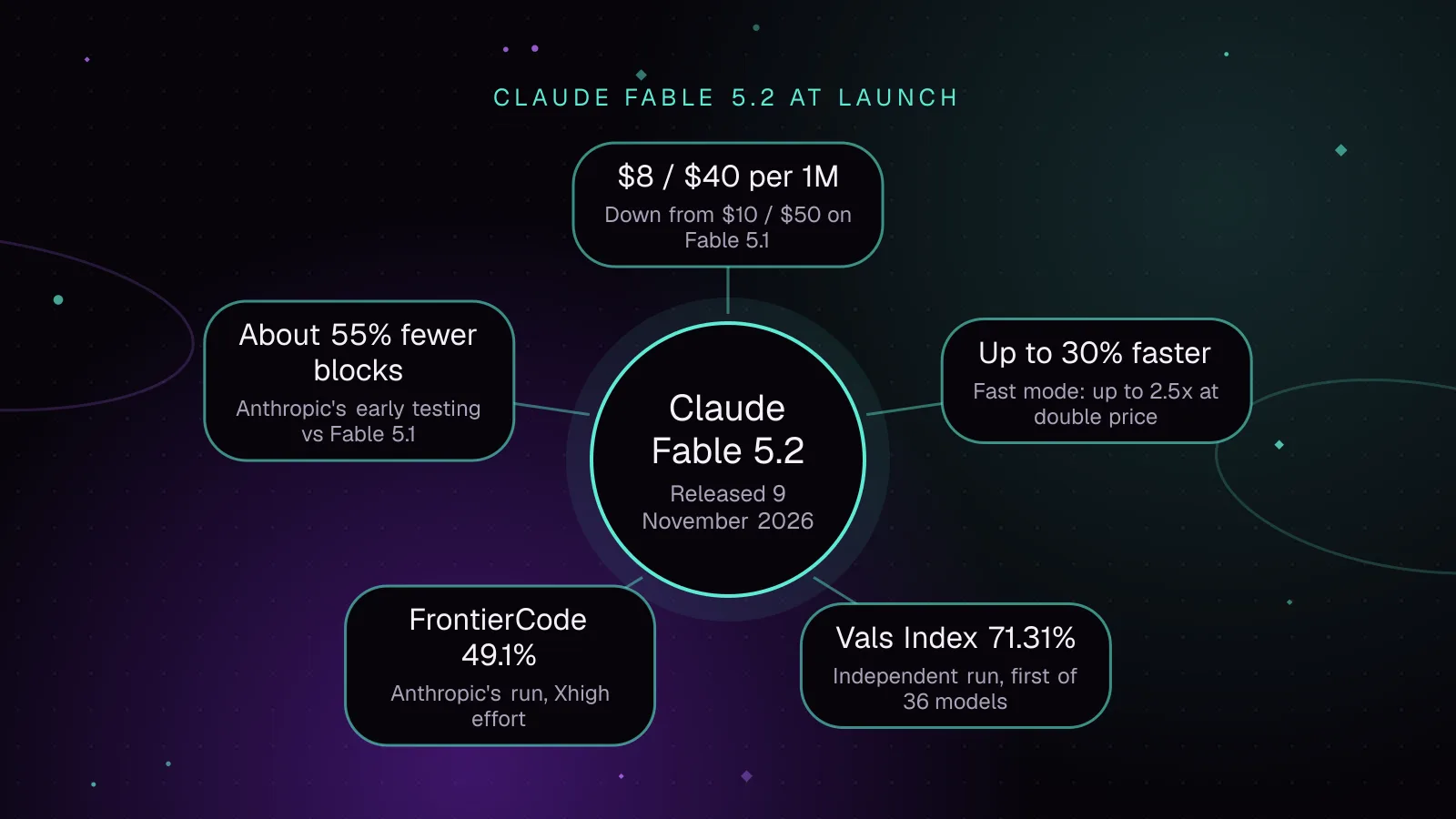
Claude Fable 5.2 is Anthropic's newest top model, released on Monday, 9 November 2026, alongside a restricted sibling called Claude Mythos 5.2. Fable 5.2 is generally available on paid Claude plans, in Claude Code, on the Claude Platform as claude-fable-5-2, and through Amazon Web Services, Google Cloud and Microsoft Azure. It costs $8 per million input tokens and $40 per million output tokens, down from $10 and $50 for Fable 5.1.
The short version, as of 9 November 2026: Anthropic's own tables put Fable 5.2 ahead of Fable 5.1 on every benchmark it published, and ahead of Opus 5.5 on most of them. The first independent run, from Vals AI, ranks it first of 36 models on the Vals Index. It is not first everywhere, though, and Anthropic itself still recommends Opus 5.5 as the everyday model.
This article separates three kinds of evidence: what Anthropic measured, what an outside lab measured, and what developers said after a few hours with it.
What changed from Fable 5.1 to Fable 5.2?
The headline changes are price, speed and fewer unnecessary refusals. Everything in this table comes from Anthropic's announcement (opens in a new tab) unless noted.
| Fable 5.1 | Fable 5.2 | |
|---|---|---|
| Input price per million tokens | $10 | $8 |
| Output price per million tokens | $50 | $40 |
| Output speed | baseline | up to 30% faster |
| Fast mode | not listed | up to 2.5 times faster generation, at $16 / $80 per million tokens |
| Default effort in Claude apps and Claude Code | not stated | Medium |
| Safety-classifier blocks in early testing | baseline | about 55% fewer (60% fewer in cybersecurity, 40% fewer in biology) |
| Context window and max output | not compared here | 1M and 128k tokens, as listed by Vals AI |
Fast mode is available in Claude Code, the Claude Platform, Google Cloud and Microsoft Foundry. Amazon Bedrock is not on Anthropic's fast-mode list.
On plans, Anthropic says Fable is included for up to 50% of weekly usage limits on Pro plans and standard Team seats, and that subscribers get one to three Fable resets depending on how long they have subscribed.
Mythos 5.2 is a different case. It goes only to vetted organisations through Anthropic's Cyber Verification Program and Life Sciences Verification Program, so most teams will only ever use Fable 5.2.
What do Anthropic's benchmarks show?
Anthropic published a large comparison table. Two footnotes matter before you read any of it: scores are at each model's highest available effort unless noted, and Fable scores are with safeguards on. The full method is in the system card.
Here are the rows most relevant to software and business work:
| Benchmark (Anthropic's run) | Fable 5.2 | Fable 5.1 | Opus 5.5 | GPT-6 Astra | Gemini 4 Carbon |
|---|---|---|---|---|---|
| FrontierCode 2.0 (agentic coding) | 49.1% | 32.4% | 45.5% | 42.8% | 41.1% |
| FrontierSWE v2 (agentic coding) | 69.9% | 56.3% | 62.3% | 65.5% | 61.2% |
| AutomationBench (business workflows) | 51.4% | 31.4% | 42.5% | 41.4% | 53.9% |
| OSWorld 2.1 (computer use) | 89.3% | 83.5% | 87.2% | 79.5% | 81.5% |
| Remote Labor Index | 41.3% | 17.9% | 21.3% | 20.8% | not listed |
| Humanity's Last Exam (with tools) | 74.2% | 65.6% | 67.7% | 57.2% | not listed |
| Chartography (no tools) | 73.4% | 44.8% | 64.4% | 71.0% | 72.5% |
Three things stand out.
The coding jump over Fable 5.1 is large. FrontierCode 2.0 goes from 32.4% to 49.1%, and FrontierSWE v2 from 56.3% to 69.9%. Anthropic says 49.1% on FrontierCode 2.0 is "the highest score of any released model we've tested."
The lead over Opus 5.5 is smaller. At High effort, Anthropic says Fable 5.2 scores 45.3% on FrontierCode 2.0, about the same as Opus 5.5's best of 45.5%. The 49.1% needs Xhigh effort, which means more tokens per task.
It does not win every row. Gemini 4 Carbon beats it on AutomationBench, 53.9% to 51.4%, and Opus 5.5 is slightly ahead on one of the AA-Briefcase knowledge-work scores (1,800 Elo to 1,785).
Anthropic also gives some cost-adjusted claims. On the WANDR search benchmark, it says Fable 5.2 at Medium effort matches Opus 5.5's top score for about 40% of the cost per task. On Humanity's Last Exam, it says Fable 5.2 at Low effort matches Opus 5.5's top score for under a tenth of the cost. Those are the numbers to test against your own work, because effort settings change your bill more than the list price does.
Has anyone tested Fable 5.2 independently?
Yes, one lab so far. Vals AI (opens in a new tab) published results on release day, run at High effort on its Vals Index v2.2. These are its numbers, not Anthropic's:
| Vals AI benchmark | Fable 5.2 score | Rank |
|---|---|---|
| Vals Index (overall) | 71.31% | 1 of 36 |
| Vibe Code Bench v1.1 | 93.77% | 1 of 127 |
| Terminal-Bench 4.0 | 65.15% | 1 of 63 (tied with Opus 5.5) |
| Finance Agent v2.1 | 69.47% | 1 of 39 |
| ProgramBench | 19.00% | 1 of 66 |
| Code Migration v1.1 | 83.27% | 2 of 30 |
| SWE-bench Multimodal | 62.29% | 2 of 22 |
| Vals Legal Index | 69.17% | 20 of 37 |
| Tax Agent Bench | 32.09% | 27 of 84 |
The overall lead is narrow. Vals puts Fable 5.2 at 71.31%, ahead of Claude Sonnet 5.5 at 70.85% and Gemini 4 Carbon at 70.45%, with a margin of error of about ±0.96 points on Fable's score. On SWE-bench Multimodal, Opus 5.5 scores higher, 70.21% to 62.29%. On the Vals Science Index, GPT-6 Astra is ahead.
Vals also lists a cost of $17.94 per Vals Index test and a refusal rate of 0.00% in its run. It does not compare Fable 5.2 with Fable 5.1, so Anthropic's speed and "fewer blocks" claims have no outside check yet.
The legal and tax rankings are the useful warning. A model at the top of an overall index can still sit mid-table on a specific job, which is why a short test on your own tasks beats any leaderboard.
As of 9 November 2026, I found no Fable 5.2 entry from Artificial Analysis, LMArena or METR. Anthropic says the UK AI Security Institute, Frontier Design and METR tested the models before release, and also says none of those organisations reviewed its announcement or system card.
What are early users and developers saying?
There are two groups here, and they deserve different weight.
The first group is the companies Anthropic quotes in its announcement. They had early access, and Anthropic chose the quotes, so read them as testimonials. A few are specific enough to be useful. Snowflake's Bala Kasiviswanathan called it "the strongest model we have measured on data-eng-bench." Fundamental Research Labs' Jeffrey Liu said it "scored 91% on our eval versus 86% for the next best model." Cognition's Adhyyan Sekhsaria said it "says it doesn't know things instead of hallucinating."
The second group is developers on the Hacker News launch thread (opens in a new tab), which had about 80 comments within its first hour. Few had run anything yet. The practical reports were small: one user found the model already available in Claude Code, which they did not expect so soon. Others repeated the price cut as the most welcome change. Opinions on writing quality were split, with one user calling Claude's writing style "terrible compared to GPT or Gemini" and others defending Opus 5.5. A long sub-thread argued that Opus 5.5 had been quietly weakened before the launch; other commenters disputed it and linked a tracker that showed no regression, and nobody posted measurements.
Some readers were also surprised by the numbering, since the new flagship is 5.2 while Opus is at 5.5. Anthropic did not explain it.
On the business side, CNBC reported (opens in a new tab) that the launch comes as Anthropic prepares an IPO that could happen as soon as next week. Dianne Penn, Anthropic's head of product management for research, told CNBC the model is meant for "power users or power use cases" in areas such as engineering, mathematics and robotics.
What does Fable 5.2 cost per task?
The list price is 20% lower on both input and output. The bill depends on how many tokens a task uses, and higher effort settings use more.
Here is the arithmetic for one task that reads 100,000 tokens and writes 20,000:
| Model and mode | Input cost | Output cost | Total |
|---|---|---|---|
| Fable 5.1 | $1.00 | $1.00 | $2.00 |
| Fable 5.2, standard | $0.80 | $0.80 | $1.60 |
| Fable 5.2, fast mode | $1.60 | $1.60 | $3.20 |
Fast mode doubles the price for up to 2.5 times faster generation. That suits a developer waiting on Claude Code. For overnight batch work, it is money spent on nothing.
Anthropic also says Fable 5.2 at Medium effort completes hard tasks with fewer tokens than Fable 5.1 did. If that holds for your work, the saving is larger than 20%. Measure it before you budget on it.
Should you switch to Claude Fable 5.2?
Anthropic's own advice, as quoted by 9to5Mac (opens in a new tab), is to start most work with Opus 5.5 and use Fable for the hardest problems. The benchmarks support that split. Fable 5.2 pulls ahead on long agentic tasks, complex coding and research, while Opus 5.5 stays close or ahead on several everyday measures.
A sensible rule for teams:
- If you already run Fable 5.1, move to Fable 5.2. Every published row improves and the price is lower. Re-run your own checks first, because default effort and refusal behaviour both changed.
- If you run Opus 5.5 and are happy with it, test Fable 5.2 only on the tasks where Opus struggles: multi-step agents, large refactors, long research jobs.
- If you build a customer-facing feature, such as a chatbot or form replies, the cheaper models usually do that job. Pay for Fable only when a test shows the difference.
Copy this model evaluation checklist
Use it to compare Fable 5.2 with whatever you run now. Twenty real tasks tell you more than any leaderboard row above.
MODEL SWITCH CHECKLIST: Claude Fable 5.2

Current model:
Candidate: claude-fable-5-2
Effort level tested: Low / Medium / High / Xhigh / Max

1. TASK SET
   20 real tasks from the last month (not made-up prompts)
   Include 5 that the current model got wrong

2. FOR EACH TASK, RECORD
   Correct? Yes / Partly / No
   Input tokens:          Output tokens:
   Cost at list price:
   Time to finish:
   Refused or blocked? Yes / No

3. COMPARE
   Tasks fixed by the new model:
   Tasks broken by the new model:
   Cost per correct answer, old vs new:

4. DECIDE
   Switch all / switch hard tasks only / stay
   Re-test date:
Count cost per correct answer, not cost per call. A model that costs more per call but needs fewer retries can still be cheaper.
Where Fable 5.2 fits in a business workflow
The model choice matters less than the controls around it. An agent built on Fable 5.2 still needs fixed permissions, human approval for anything that moves money or data, and a log you can audit. That holds for every model on this page.
If you are unsure whether a task needs a model at all, rule-based automation versus AI covers where plain code is the better choice. For running costs, see what AI automation costs a small business. If you want a model like this wired into WordPress, WooCommerce or your own systems with those limits in code, that is the work behind AI integration for business workflows.
Frequently asked questions
When was Claude Fable 5.2 released?
Anthropic released Claude Fable 5.2 on Monday, 9 November 2026, together with Claude Mythos 5.2. Fable 5.2 was available the same day on paid Claude plans, in Claude Code, on the Claude Platform and through AWS, Google Cloud and Microsoft Azure.
How much does Claude Fable 5.2 cost?
Standard pricing is $8 per million input tokens and $40 per million output tokens, 20% less than Fable 5.1's $10 and $50. Fast mode costs $16 and $80 per million tokens for up to 2.5 times faster generation.
Is Claude Fable 5.2 better than Opus 5.5?
On most of Anthropic's own benchmarks, yes, but the gap is often small. Vals AI's independent run ranks Fable 5.2 first overall, while Opus 5.5 scores higher on SWE-bench Multimodal and ties it on Terminal-Bench 4.0. Anthropic still recommends Opus 5.5 for everyday work.
What is the API model name for Claude Fable 5.2?
On the Claude Platform the model ID is claude-fable-5-2. Cloud providers such as AWS, Google Cloud and Azure may use their own identifiers, so check each provider's model list.
What is the difference between Fable 5.2 and Mythos 5.2?
Both come from the same release and share the same list price. Fable 5.2 is generally available. Mythos 5.2 is limited to vetted organisations in Anthropic's Cyber and Life Sciences Verification Programs because of its dual-use capabilities.
How this article was made: drafted with AI assistance from a researched brief, then checked against primary documentation before publishing.
Share this article
Enjoyed this? Get the next article by email.
Keep reading
 Development
8 min read
AI lead routing for WordPress inquiries with a review queue
AI lead routing on a WordPress site should do one small job: turn each incoming inquiry into an approved route or a human review item.
- AI
- Automation
- Forms
 Development
4 min read
AI automation for small businesses: where to start
AI automation for small businesses is most useful when it handles a repeatable step that someone can check. Start with one workflow, such as sorting incoming enquiries or drafting a reply for review. Decide who owns the result, how mistakes will be caught and what happens when a connection fails.
- Automation
- Web Development
- Small Business
 Security
11 min read
AI agents in US bank accounts: what banks found and what to do now
AI agents accessing bank accounts have prompted major US banks to tighten security after Axios reported on Thursday, 22 October 2026, that third-party assistants were operating inside customer accounts, sometimes beyond user instructions.
- AI
- Security
- Automation